
Basement Bedrooms
Basement bedrooms planned around egress, closets, lighting, insulation, and code.
Basement Bedrooms in Utah
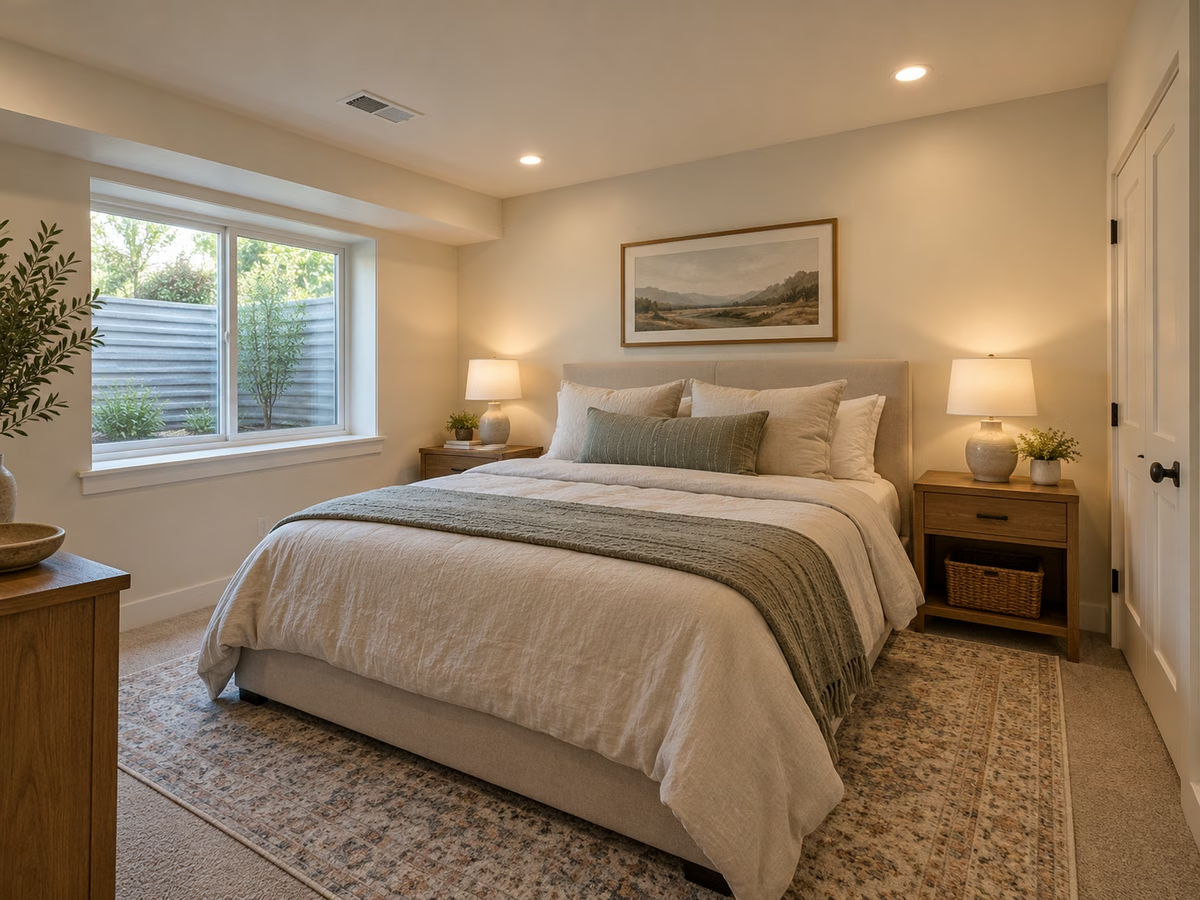
Basement bedrooms are a practical way to add sleeping space without adding onto the house. Adding bedrooms to your basement is the most cost-effective way to give everyone their own space, at a fraction of what a home addition or a bigger house would cost. A basement bedroom runs $8,000 to $20,000 depending on finishes, compared to $40,000+ for a built-on addition.
Utah Basement Finishing builds code-compliant basement bedrooms with proper egress windows, ventilation, and fire safety features. Plan around the actual occupant, access route, intended use and permit requirements, whether the room is for household members or guests.
What We Offer
Standard Basement Bedrooms
- Framing and an insulation assembly specified for the actual project and applicable energy-compliance path
- Egress window installation (required by code for every sleeping room)
- Closet with shelf and rod
- Recessed LED lighting on dimmer switches
- Solid-core door for sound reduction
- LVP flooring or carpet
- Paint with your choice of colors
- Electrical outlets per code spacing (every 12 feet)
- Smoke detector and CO detector
Upgraded Bedroom Features
- Walk-in closets with custom organizer systems (ClosetMaid, Elfa, or custom-built)
- Ensuite bathroom - connected private bathroom
- Sound insulation - R-19 batts in interior walls plus resilient channel on ceiling for reduced noise transfer from upstairs
- Accent walls - shiplap, board-and-batten, or wood slat panels
- Built-in desk area for kids’ study space or remote work
- USB outlets and data ports - modern essentials
- Window treatments - blackout cellular shades (especially important for basement bedrooms where egress wells let in direct morning light)
Egress Window Installation
Every basement bedroom in Utah must have an egress window that meets IRC requirements:
- Minimum opening area: 5.7 square feet
- Minimum opening width: 20 inches
- Minimum opening height: 24 inches
- Maximum sill height: 44 inches from the floor
We handle the complete egress window installation, cutting through the foundation wall, excavating the window well, installing the window frame and well liner, adding a well cover, and ensuring proper drainage at the bottom of the well. The result: natural light, emergency escape, and code compliance.
Our Process
Step 1: Layout Planning
We assess your basement’s dimensions, existing mechanical systems, and natural features to determine the best bedroom locations. Bedrooms need to be placed where egress windows can be installed (exterior walls with adequate clearance outside).
Step 2: Permits and Engineering
We submit plans showing bedroom dimensions, egress window specs, electrical layout, and smoke/CO detector placement. If the foundation cut for the egress window requires structural engineering review, we coordinate that too.
Step 3: Build
Foundation cutting and egress window installation happen first, followed by framing, electrical, insulation, drywall, flooring, and trim. A single bedroom addition takes 2-3 weeks; multiple bedrooms as part of a full finish take 4-8 weeks.
Step 4: Final Inspection
The building inspector verifies egress window dimensions, electrical, smoke detectors, and closet requirements. We handle scheduling and any corrections.
Cost Range
| Bedroom Configuration | Cost Range |
|---|---|
| Standard bedroom (no egress needed, window exists) | $5,000–$10,000 |
| Standard bedroom + new egress window | $8,000–$16,000 |
| Bedroom with walk-in closet + egress | $10,000–$18,000 |
| Master-style bedroom + ensuite bath + egress | $20,000–$35,000 |
| Egress window only (added to existing room) | $3,500–$6,000 |
Key cost factors:
- Egress window installation adds $3,500–$6,000 per window (foundation cutting, excavation, window, well, and cover)
- Soil conditions matter, rocky soil (common in Draper, Sandy bench areas) increases excavation cost
- Sound insulation upgrades add $500–$1,500 per room
- Flooring choice: carpet ($3–$5/sq ft installed) vs. LVP ($5–$8/sq ft installed)
Why Choose Us for Basement Bedrooms
- Egress planning - assess the actual opening, escape route, foundation and applicable requirements before cutting
- Foundation cutting experience - cutting into concrete block or poured concrete walls requires precision. We use diamond-blade concrete saws for clean cuts without cracking
- Code compliance guaranteed - every bedroom passes final inspection
- Proper sound isolation - we understand that basement bedrooms under living rooms need acoustic treatment to be comfortable
- Attention to details - proper closet dimensions, outlet placement, lighting levels, and door swing clearances that make a bedroom feel right
Frequently Asked Questions
Is a basement bedroom legal in Utah? Yes, as long as it meets building code requirements, specifically an egress window, minimum ceiling height (7 feet), minimum room size (70 square feet with no dimension less than 7 feet), a closet, smoke detector, and CO detector. We build every bedroom to meet these requirements.
Do I really need an egress window for a basement bedroom? Yes. Utah follows the International Residential Code, which requires an egress window in every sleeping room. This is a life-safety requirement, it provides an emergency escape route if the interior stairs are blocked by fire. There are no exceptions.
Can a basement bedroom count as a legal bedroom for real estate purposes? Yes, if it has a permitted egress window, meets minimum size requirements, has a closet, and was built with a permit. A “non-conforming” bedroom (no egress) can’t be listed as a bedroom when selling the home, which directly affects your home’s appraised value.
How much natural light will a basement bedroom get? Egress windows are significantly larger than standard basement windows. Combined with a properly sized window well (we recommend oversized wells with white or light-colored liners), you’ll get a surprising amount of natural light. It won’t be identical to an above-grade bedroom, but with good lighting design, it feels comfortable and bright.
What about noise from upstairs? We address this with sound insulation, R-19 fiberglass batts in the ceiling joists above the bedroom, plus resilient channel (metal strips that decouple the drywall from the joists) for additional sound dampening. The combination reduces footstep and voice noise significantly. For maximum sound reduction, we can also add a second layer of 5/8” drywall with Green Glue compound between layers.
Can you build a bedroom in a basement with 7.5-foot ceilings? Yes. After framing and drywall, you’ll lose about 4-6 inches of headroom, which still keeps you above the 7-foot minimum. We use recessed lighting and flush-mount ductwork to avoid eating into ceiling height further.
Need more bedrooms? Call 801-515-3473 for a free basement bedroom estimate.
Bedroom layout ideas that work beyond the photograph
Decide whether the room is for everyday sleeping, occasional guests or a teen’s changing needs. Place the actual bed and storage on the plan, including open drawers and the route to the door. Light finishes, warmer accents and suitable lighting can shape the room’s character without replacing the need for usable circulation.
Review the applicable emergency escape and rescue provisions before committing to furniture or cabinetry. An opening, its operating clearance and any well or exterior access must remain usable; storage should not obstruct the required route. Confirm the actual requirements and any applicable exceptions with the local authority rather than assuming every bedroom has an identical window solution.
For someone with changing mobility needs, assess the route downstairs and access to a bathroom as well as the bedroom itself. Read aging-in-place suitability before assuming an available basement room is the best place for daily living.
Related basement planning pages.
This service is usually one part of a larger basement plan. These pages help compare scope, cost, service areas, and the next estimate step.
Utah Basement Finishing Guide
See how full basement projects are planned, permitted, and built.
Basement Remodeling Utah
Compare finishing raw space with remodeling an existing basement.
Utah Basement Cost Guide
Use current planning ranges before comparing contractor bids.
Basement Cost Calculator
Get a rough budget range instantly from your square footage and scope.
Basement Finishing Near You
Find the service-area page for your city or county.
Request a Free Estimate
Send the basics and get the next step for your basement.