
Home Theater Rooms
Basement theater rooms with planned lighting, sound, seating, and clean wiring.
Basement Home Theater Rooms in Utah
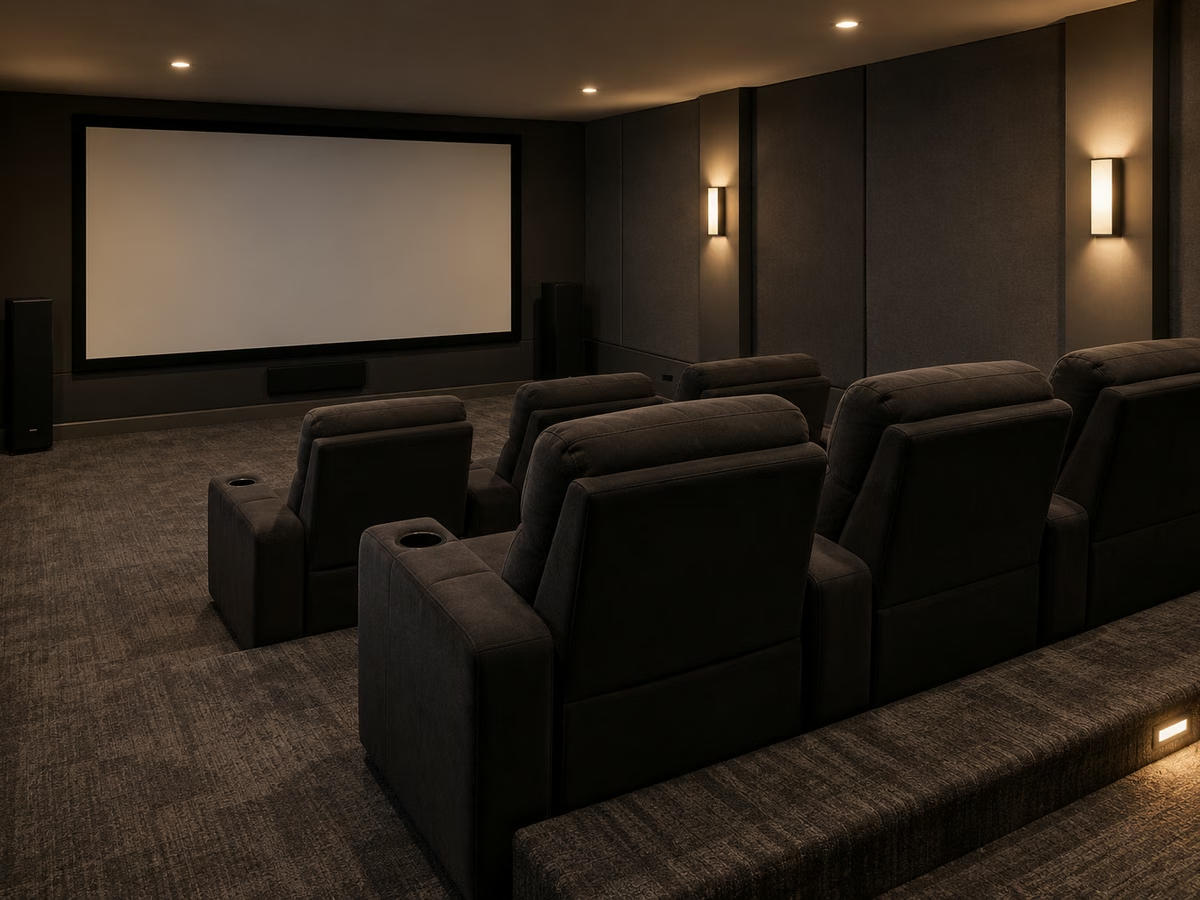
A dedicated theater room works well in a basement because the space is naturally darker and more isolated from the main floor. That helps with light control, sound control, and seating layout.
Utah Basement Finishing designs and builds custom home theater rooms that go far beyond mounting a TV on the wall. We handle the room design, acoustic treatment, electrical and low-voltage wiring, lighting control, tiered seating platforms, and finish work to create a theater experience that rivals commercial cinemas.
What We Offer
Room Design and Acoustics
- Room sizing optimization - ideal theater rooms are 1.5 to 2 times as long as they are wide. We design the space to maximize screen size and seating distance
- Acoustic treatment - absorptive panels on first reflection points, bass traps in corners, diffusion panels on the rear wall. We use Owens Corning 703 panels wrapped in acoustically transparent fabric
- Sound isolation - plan the complete wall/ceiling assembly, doors, seals, ducts and penetrations to reduce transmission. Bass and flanking paths require separate consideration; no assembly description alone guarantees inaudibility upstairs.
- Dark color schemes - dark walls and ceiling eliminate light reflections that wash out the image
Audio/Video Pre-Wiring
- Surround sound - pre-wired for 5.1, 7.1, or Dolby Atmos configurations (including ceiling-mounted height channels)
- Subwoofer placement - dedicated power and signal runs to optimal subwoofer locations
- Projector mount - structural backing in the ceiling, power outlet, and HDMI conduit to the equipment location
- Screen wall - framed and wired for a fixed-frame projection screen (Stewart, Silver Ticket, or Elite Screens)
- Equipment closet - ventilated cabinet or closet for receivers, media players, and gaming consoles with dedicated power circuit
Seating and Platforms
- Tiered seating risers - built-up platforms (typically 12 inches per row) so the second and third rows have an unobstructed view
- Theater seating areas - framed and wired for powered recliners (dedicated outlets per seat)
- LED step lighting on risers for safety
- Cup holder and accessory power - USB charging integrated into seating platforms
Lighting
- Dedicated lighting zones - dimmable overhead, LED rope lighting along risers, wall sconce accents, and star ceiling fiber optics (optional)
- Smart lighting control - Lutron Caseta or similar system that integrates with your AV remote
- Blackout conditions - no light leaks from doorways, HVAC vents, or outlets
Climate Control
- Dedicated HVAC zone - a room full of people and electronics generates heat. We either extend ductwork with a dedicated zone damper or install a mini-split for independent temperature control
- Quiet ducting - insulated flex duct with low-velocity design to minimize air noise. A theater room should have no audible HVAC noise at normal listening levels
Our Process
Step 1: Consultation and Design
We discuss your vision, screen size preferences, audio format (5.1 vs. Atmos), seating capacity, and budget. We’ll recommend room dimensions and equipment placement based on your space.
Step 2: Technical Planning
We create a wiring plan for all audio, video, power, lighting, and control runs. Every cable has a destination planned before walls go up. We also plan acoustic treatment placement and HVAC routing.
Step 3: Construction
Framing, wiring, acoustic insulation, drywall (with sound isolation assemblies), painting, flooring, riser construction, and trim. Theater rooms typically take 3-5 weeks within a larger basement project.
Step 4: Testing and Calibration
We verify all wiring, test every speaker location, and confirm projector/screen alignment. If you’re having a professional AV installer handle equipment, we coordinate access and ensure everything is ready for their setup.
Cost Range
| Theater Configuration | Cost Range |
|---|---|
| Basic theater room (pre-wired, painted, no riser) | $15,000–$25,000 |
| Mid-range (risers, acoustic treatment, lighting) | $25,000–$45,000 |
| Premium (full acoustic isolation, Atmos wiring, star ceiling) | $40,000–$70,000+ |
Note: These costs cover the room construction, wiring, and finish work. AV equipment (projector, screen, receiver, speakers) is separate, budget $3,000–$15,000+ depending on your preferences.
Common add-ons:
- Tiered seating riser: +$2,000–$5,000
- Full acoustic isolation (double drywall + Green Glue): +$3,000–$6,000
- Star ceiling (fiber optic): +$2,000–$5,000
- Smart lighting system: +$1,500–$3,000
- Mini-split HVAC: +$3,000–$5,000
Why Choose Us for Home Theater Rooms
- Acoustic design knowledge - we understand first reflections, RT60, and bass management. Your theater will sound right, not just look right
- Low-voltage wiring expertise - clean cable runs with labeled terminations, proper conduit for future upgrades, and structured wiring panels
- Construction quality - sound isolation is only as good as the weakest link. We seal every gap, outlet box, and duct penetration to maintain acoustic integrity
- Collaboration with AV installers - we work with several Utah AV companies and coordinate with your preferred installer to ensure the room is built to their specifications
Frequently Asked Questions
What’s the ideal room size for a basement home theater? A room that’s 12-15 feet wide and 18-22 feet long works well for most setups, accommodating a 120-135 inch projection screen with two rows of seating. Smaller rooms (10x14) work for a single-row setup with a 100-110 inch screen. We’ll optimize your specific space.
Projector or large TV? For a dedicated theater room, projectors deliver screen sizes (100-150 inches) that even the largest TVs can’t match. Modern 4K laser projectors from Epson, BenQ, and JVC can produce sharp images in dark rooms. For multi-purpose rooms where you can’t fully control light, an 85” TV might be more practical.
Do you install the AV equipment? We focus on the room construction, wiring, and pre-installation infrastructure. For equipment installation, calibration, and programming, we recommend working with a local AV integrator. We partner with several in the Salt Lake area and can provide referrals.
How soundproof can you make it? Additional drywall, damping, properly detailed isolation, sealed doors and coordinated ductwork can reduce transmission. STC compares airborne transmission through tested assemblies; it is not a direct subtraction from movie volume or a guarantee of privacy. Bass, footsteps, penetrations and other flanking paths need separate attention. Review the soundproofing guide and ask which complete assembly supports a proposed rating.
Can I build a theater room in a basement with 8-foot ceilings? Yes, though it affects seating riser height. With 8-foot ceilings, we typically limit risers to 8-10 inches per step (instead of 12) and use compact recessed fixtures. The theater experience is still excellent, most commercial cinemas have lower ceilings than you’d expect.
What about wiring for future upgrades? We run conduit (not just cables) for video and audio runs, making it easy to pull new cables in the future. HDMI standards change regularly, and conduit means you can upgrade to HDMI 2.1 or whatever comes next without opening walls.
Build a basement theater that fits the room. Call 801-515-3473 for a free estimate.
Related basement planning pages.
This service is usually one part of a larger basement plan. These pages help compare scope, cost, service areas, and the next estimate step.
Utah Basement Finishing Guide
See how full basement projects are planned, permitted, and built.
Basement Remodeling Utah
Compare finishing raw space with remodeling an existing basement.
Utah Basement Cost Guide
Use current planning ranges before comparing contractor bids.
Basement Cost Calculator
Get a rough budget range instantly from your square footage and scope.
Basement Finishing Near You
Find the service-area page for your city or county.
Request a Free Estimate
Send the basics and get the next step for your basement.