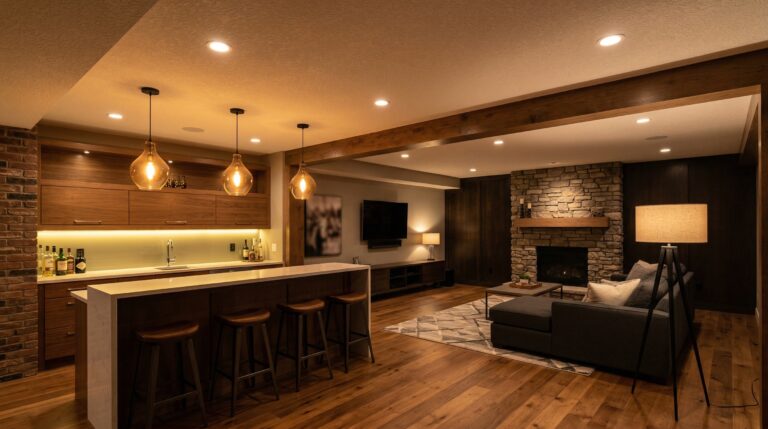
A home gym in the basement makes too much sense to ignore. The temperature stays consistent year-round (no sweltering garage in summer), the concrete floor handles heavy equipment, the ceiling is high enough for most exercises, and the noise stays contained below grade. No commute, no monthly fees, no waiting for equipment, no judgment. Just your space, your rules, your workout.
We’ve built dedicated gym spaces in hundreds of Utah basements. Here’s everything you need to know — from budget-friendly setups to premium builds.
Foundation: Getting the Space Right
1. Rubber Flooring (Non-Negotiable)
Before anything else, get the floor right. Rubber flooring is the #1 investment for a basement gym.
Options:
– Interlocking rubber tiles — 3/8″ to 3/4″ thick. Easy to install, easy to replace individual tiles. Best for general fitness. ($2-$4/sq ft)
– Rolled rubber — 1/4″ to 1/2″ thick. Seamless surface, stays flat. Best for cardio areas and yoga. ($1.50-$3/sq ft)
– Stall mats — 3/4″ thick horse stall mats from Tractor Supply ($2/sq ft). The budget king. Heavy, durable, and functional. They smell for a few weeks.
– Platform with plywood + rubber — For Olympic lifting. Build a 8×8 platform with 3/4″ plywood base and rubber on the sides. ($100-$300 DIY)
Pro Tip: For heavy lifting areas (deadlifts, Olympic lifts), go 3/4″ thick minimum. For cardio and general fitness, 3/8″ is sufficient. Don’t put thin rubber under a squat rack — it compresses and becomes unstable.
2. Proper Ventilation
Basements have limited natural airflow. When you’re working hard, you generate heat, moisture, and CO2. Without ventilation, your basement gym becomes a sauna — and not the good kind.
Solutions by budget:
– Budget: High-velocity fan ($50-$100) pointed at the workout area
– Mid-range: Ceiling-mounted exhaust fan venting to exterior ($200-$500 installed)
– Premium: Mini-split AC/heat system ($2,000-$4,000 installed) — year-round temperature control independent of your home’s HVAC
Cost: $50-$4,000
3. Lighting That Energizes
Dim, flickering fluorescent lights kill workout motivation. Bright, cool-toned LED lighting creates an energized, gym-like atmosphere.
Recommendations:
– 5000K-6000K LED shop lights or panels — Bright daylight color temperature
– Multiple fixtures for even coverage (no dark corners)
– Dimmable for yoga or stretching sessions
– LED strip accents along mirrors or ceiling perimeter for atmosphere
Cost: $100-$500 for the entire space
4. Wall-to-Wall Mirrors
Mirrors serve a functional purpose — checking form, tracking progress, and making the space feel larger.
- Mount on the longest wall
- Full-height if budget allows (floor to 6+ feet)
- Gym mirror panels from commercial suppliers ($50-$150 per 4×6 panel)
- Secure mounting (mirror clips + adhesive — these must NOT fall during a heavy set nearby)
Cost: $200-$800
Gym Layouts by Space
5. Compact Gym (100-150 sq ft)
Even a 10×12 space can be a functional gym. Focus on versatility over quantity.
Essential equipment:
– Adjustable dumbbells (Bowflex, PowerBlock) — replace an entire dumbbell rack
– Adjustable bench (flat to incline)
– Pull-up bar (wall or ceiling mounted)
– Resistance bands anchored to the wall
– Yoga mat area
– Jump rope space (need 2 feet of clearance around you)
Layout tip: Mount everything possible on walls. Floor space is for movement.
6. Mid-Size Gym (200-350 sq ft)
Now we’re talking. 15×20 feet gives you room for both strength and cardio.
Recommended setup:
– Power rack or half rack with pull-up bar
– Olympic barbell and bumper plates
– Adjustable bench
– Cable machine or functional trainer
– One cardio machine (rower, bike, or treadmill)
– Dumbbell rack (or adjustable set)
– Mirror wall
– Rubber flooring throughout
7. Premium Home Gym (400+ sq ft)
The full commercial gym experience at home.
Full setup:
– Power rack with lat pulldown attachment
– Dedicated deadlift platform
– Cable crossover or functional trainer
– Full dumbbell rack (5-75 lbs)
– Multiple cardio machines
– Stretching/yoga area with mats
– Sound system
– TV mounted for workout programming
– Water fountain or mini-fridge
– Towel hooks and sanitizer station
Cost to build the room: $5,000-$15,000 (not counting equipment)
Specialty Gym Ideas
8. CrossFit / Functional Training Box
Open floor space with minimal fixed equipment. Designed for WODs, circuit training, and functional movement.
Key features:
– Open floor space (minimum 12×16 feet clear)
– Wall-mounted pull-up rig (not freestanding — saves space)
– Wall ball target at 9 and 10 feet
– Plyo box set
– Kettlebell rack
– Slam balls
– Assault bike or rower
– Timer clock mounted on the wall
– Whiteboard for WOD tracking
Ceiling height matters: You need 9+ feet for wall balls, box jumps, and overhead movements. If your ceiling is under 8.5 feet, modify the programming.
9. Yoga / Pilates Studio
Calm, clean, and focused on flexibility and mindfulness.
Design elements:
– Cork or high-quality rubber flooring (softer than gym rubber)
– Warm, dimmable lighting (2700K-3000K)
– Mirror on one wall
– Barre mounted at hip height along one wall
– Sound system for meditation music
– Minimal equipment: mats, blocks, straps, Pilates reformer
– Neutral, calming color palette
– Essential oil diffuser
– Natural elements — plants, wood accents
Cost: $3,000-$8,000 (room build)
10. Boxing / MMA Training Room
Aggressive, functional, and stress-relieving.
Setup:
– Heavy bag (100+ lbs) — mounted from ceiling joist or beam. Verify structural support — a 100-lb bag swinging generates significant dynamic loads
– Speed bag with wall platform
– Double-end bag
– Heavy floor mats (2″ thick for groundwork)
– Timer clock
– Mirror wall
– Jump rope area with adequate clearance
– Resistance bands for shadowboxing
Pro Tip: When mounting a heavy bag in a basement, bolt the mount through a floor joist — NOT into drywall or a ceiling tile. Use a dedicated heavy bag mount rated for the bag’s weight plus dynamic load (typically 3x the bag weight). We reinforce the framing for heavy bag mounts during the finishing process.
11. Spin / Cycling Studio
A dedicated cycling room with the energy of a studio class.
Features:
– Peloton, Wahoo, or DIY spin bike setup
– Large TV or projector for classes
– Dedicated fan pointed at riding position
– Sweat-resistant flooring (rubber or LVP)
– Sound system with bass
– LED mood lighting (RGB strips that sync with intensity)
– Towel bar and water bottle shelf
Cost: $2,000-$5,000 (room build, not bike)
12. Climbing / Bouldering Wall
An indoor climbing wall section for training and fun.
Requirements:
– Plywood panels (3/4″ ACX) with T-nut pattern
– Climbing holds (variety pack: $100-$500)
– Crash pad or 6″+ foam floor padding below
– Minimum 8-foot ceiling
– Structural mounting into studs/joists (climbing loads are lateral, not just vertical)
– Optional: adjustable angle wall section for overhangs
Cost: $3,000-$10,000
13. Sauna + Recovery Room
Post-workout recovery right next to your gym.
Components:
– Infrared or traditional sauna unit ($2,000-$8,000)
– Cold plunge tub or cold shower ($500-$5,000)
– Foam rolling and stretching area
– Massage gun/equipment storage
– Towel hooks and robe storage
– Waterproof flooring
– Proper ventilation and drainage
Cost: $5,000-$15,000
Smart Additions
14. Sound System
Music makes workouts better. Period.
Options:
– Bluetooth speaker ($50-$300) — simplest setup
– In-ceiling speakers wired to an amp ($500-$1,500) — clean, integrated
– Soundbar below the TV ($200-$500)
Key consideration: Bass matters for workout music. In-ceiling speakers or a dedicated subwoofer deliver the energy that a phone speaker can’t.
15. TV / Screen Setup
For following workout programs, streaming classes, or watching sports while on cardio.
- Wall-mounted TV (43-65″) at eye level from your primary workout position
- Ceiling mount if wall space is limited
- Swivel mount so you can see it from different stations
- Smart TV or streaming device for Peloton, Apple Fitness+, YouTube workouts
16. Electrical Planning
Gym equipment has real electrical demands. Plan circuits before the walls go up.
What you need:
– Dedicated 20-amp circuit for treadmills and ellipticals (they draw 15-20 amps at startup)
– Additional outlets along multiple walls for fans, speakers, TV, and smaller equipment
– USB charging outlets near cardio equipment
– GFCI protection if the gym is near any water source
17. Storage Solutions
Equipment needs a home when not in use.
- Wall-mounted plate storage tree
- Kettlebell shelf
- Dumbbell rack
- Resistance band hooks
- Foam roller and mat storage
- Jump rope hooks
- Shoe rack by the door
18. Motivational Design Elements
The details that make you want to show up every day.
- Custom wall graphics or motivational quotes (vinyl decals: $20-$100)
- Progress tracking whiteboard
- PR bell (hang a bell to ring after setting a personal record)
- Before/after photo spot with consistent lighting
- Branded gym name (why not?)
- Plant or two for oxygen and aesthetics
Home Gym Cost Summary
| Level | Room Build Cost | Equipment Budget | Total |
|---|---|---|---|
| Budget corner gym | $1,000-$3,000 | $500-$2,000 | $1,500-$5,000 |
| Dedicated room (basic) | $3,000-$8,000 | $2,000-$5,000 | $5,000-$13,000 |
| Mid-range gym | $5,000-$12,000 | $5,000-$10,000 | $10,000-$22,000 |
| Premium build | $10,000-$20,000 | $10,000-$30,000 | $20,000-$50,000 |
Build Your Basement Gym
Stop paying for a gym membership you use three times a month. Build a basement gym you’ll use every day. Utah Basement Finishing handles the room — rubber flooring, electrical, ventilation, mirrors, and everything that makes the space work.
Call 801-515-3473 or get your free estimate.
Ready to Start Your Basement Project?
Get a free, no-obligation quote from Utah's trusted basement finishing experts.
Get Free Quote