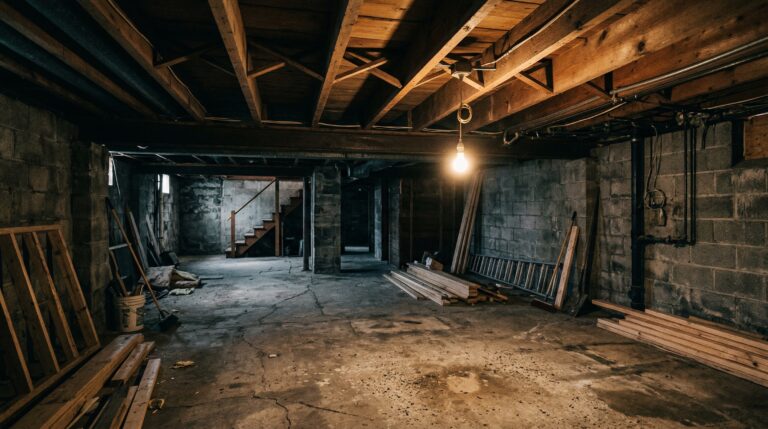
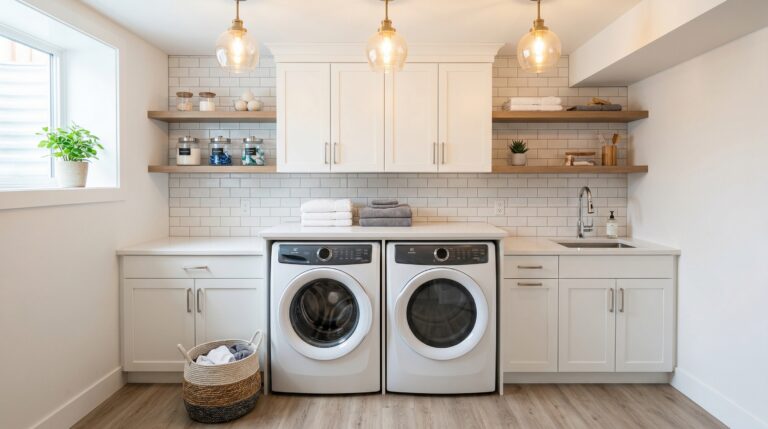
The #1 complaint about basements: they’re dark. Natural light is limited (or nonexistent), ceilings are often lower than upstairs, and bad lighting makes even a well-finished basement feel like a cave.
Good lighting fixes all of it. Here are 20 ideas that actually work.
Recessed Lighting Ideas
1. Grid Layout Recessed LEDs
The backbone of basement lighting. A evenly-spaced grid of 4″ or 6″ recessed LED cans provides consistent, shadow-free light across the entire space. Space them based on ceiling height — for 8-foot ceilings, place 6″ cans every 6 feet in a grid pattern.
Cost: $75-$150 per fixture installed
Lumens: 800-1,200 per fixture (aim for 50 lumens per sqft total)
2. Directional Recessed for Art/Features
Adjustable “eyeball” trim on recessed cans lets you aim light at artwork, a stone accent wall, or architectural features. Mix 2-3 directional fixtures with your grid layout for visual interest.
3. Ultra-Slim LED Panels
For basements with limited ceiling clearance (7-7.5 feet), ultra-slim LED panels mount nearly flush — only 1/2 inch below the ceiling. They distribute light more evenly than standard cans and work in soffited areas where recessed cans won’t fit.
4. Perimeter Cove Lighting
LED strips hidden in a cove or ledge around the ceiling perimeter create soft, indirect ambient light. The ceiling appears to float, and the room feels taller. Install a small drywall ledge 3-4 inches from the wall, drop it 3-4 inches from the ceiling, and run LED tape inside.
Cost: $200-$600 for a full room perimeter
Pendant and Hanging Fixtures
5. Bar Pendants
Three pendants evenly spaced over a wet bar or kitchen counter define the space and provide task lighting. Industrial metal shades, glass globes, or modern geometric designs set the tone for the entire bar area.
6. Statement Chandelier
In rooms with 8.5+ foot ceilings, a chandelier in the main living area creates a focal point and elevates the space from “basement” to “room.” Modern linear chandeliers work over dining tables without hanging too low.
7. Pool Table / Game Table Light
A dedicated fixture centered over the table provides even, glare-free lighting for gameplay. Standard pool table lights hang 32-36 inches above the table surface.
Accent and Decorative Lighting
8. LED Strip Under Stairs
Run LED tape under each stair tread for a floating staircase effect. This serves as both accent lighting and a safety feature — illuminated stairs prevent trips in low light. Motion-activated is even better.
Cost: $100-$300 for a full staircase
9. Toe-Kick Lighting
LED strips under bathroom vanities, kitchen cabinets, or bar bases create a subtle glow that makes furniture appear to float. Great as nighttime navigation lighting without turning on full overhead lights.
10. Backlit Wall Panels
Backlit translucent panels (acrylic, alabaster, or onyx) create dramatic feature walls. The diffused glow adds depth and luxury. Popular behind wet bars or in home theaters.
11. Shelf and Niche Lighting
LED puck lights or strips inside built-in shelving, display niches, or glass-front cabinets highlight collectibles, books, or bottles. Creates layers of light that make the space feel finished.
12. Wall Sconces
Sconces on either side of a TV, flanking a mirror, or down a hallway add mid-level lighting that fills the gap between ceiling fixtures and floor-level accents. They add architectural interest to otherwise blank walls.
13. LED Behind TV (Bias Lighting)
An LED strip on the back of your TV reduces eye strain during movie watching and makes the screen appear brighter. Available in kits for $15-$40 that sync with on-screen colors.
Functional Lighting Ideas
14. Layered Dimming Zones
Don’t put all lights on one switch. Create zones:
– Zone 1: Main ambient (recessed grid) — dimmable
– Zone 2: Task lighting (bar, desk, workbench) — independent switch
– Zone 3: Accent lighting (LED strips, sconces) — dimmable
– Zone 4: Pathway/night lighting (toe kicks, stair lights) — separate or motion-activated
Three or four circuits with dimmers let you set the mood for movie night, game night, or full-brightness cleaning mode.
15. Smart Lighting
Smart bulbs or smart switches (Lutron Caseta, Philips Hue) let you control everything from your phone or voice assistant. Create scenes: “Movie mode” dims ambient to 10%, turns off task lights, and sets accent lights to a warm glow. “Party mode” brings everything up.
Cost: $40-$80 per smart switch, or $15-$30 per smart bulb
16. Motion-Activated Lighting
In hallways, stairways, bathrooms, and closets, motion sensors turn lights on when you enter and off when you leave. Prevents fumbling for switches in dark basement hallways and saves energy.
17. Under-Cabinet Task Lighting
Essential for wet bars, kitchenettes, and workbenches. LED strip or puck lights under upper cabinets illuminate the countertop directly. Hardwired is cleaner than battery-operated.
Natural Light Enhancement
18. Egress Window Upgrades
If you’re adding bedrooms, you need egress windows anyway. Upsize them beyond minimum code requirements — bigger windows mean dramatically more natural light. The incremental cost for a larger window is minimal compared to the impact.
19. Sun Tubes / Light Pipes
Tubular skylights capture sunlight from the roof and pipe it down through a reflective tube to the basement ceiling. They provide genuine natural light without structural modifications beyond a small ceiling opening. Models from Solatube and Velux work well in single-story-above basements.
Cost: $500-$1,500 installed
20. Light-Colored Surfaces
Not a fixture, but the most cost-effective lighting “upgrade.” Light walls (warm white, not stark white), light flooring, and white ceilings reflect and multiply whatever light you have. Dark walls absorb light — a room with dark gray walls needs twice the fixtures to feel the same brightness as one with white walls.
Lighting Layout Planning
How Many Fixtures Do You Need?
Target 50 lumens per square foot for general living areas, 70 lumens per sqft for task areas (bar, office, kitchen).
| Room Size | Target Lumens | 4″ LED Cans Needed | 6″ LED Cans Needed |
|---|---|---|---|
| 200 sqft | 10,000 | 12-14 | 8-10 |
| 400 sqft | 20,000 | 22-26 | 16-20 |
| 800 sqft | 40,000 | 45-52 | 32-40 |
| 1,200 sqft | 60,000 | 65-75 | 48-60 |
These counts assume recessed LEDs as the primary light source. Supplement with accent and task lighting to reduce the number of cans needed.
Color Temperature Guide
- 2700K (warm white): Living rooms, bedrooms, relaxation areas — cozy and inviting
- 3000K (soft white): The all-purpose sweet spot. Works everywhere and matches most upstairs lighting
- 3500K (neutral): Home offices, laundry rooms — bright without being clinical
- 4000K+ (cool white): Workshops, utility areas. Avoid for living spaces — feels institutional
Important: Pick ONE color temperature for the main living spaces. Mixing 2700K and 4000K in the same room looks wrong. Use the same Kelvin throughout connected open areas.
Ceiling Height Considerations
- 7-7.5 ft ceilings: Use flush mount or ultra-slim fixtures only. No hanging pendants except over tables/bars. Recessed cans with wide flood trim maximize spread.
- 8 ft ceilings: Standard recessed works well. Semi-flush pendants okay in defined areas.
- 9+ ft ceilings: Full design flexibility — pendants, chandeliers, and dramatic fixtures all work.
Cost Summary
| Lighting Type | Per-Fixture Cost (Installed) |
|---|---|
| 6″ recessed LED | $75-$150 |
| 4″ recessed LED | $65-$130 |
| Ultra-slim panel | $100-$200 |
| Pendant light | $100-$400 |
| LED strip (per linear foot) | $5-$15 |
| Dimmer switch | $30-$80 |
| Smart switch | $40-$80 |
| Wall sconce | $100-$300 |
Total lighting budget for a 1,200 sqft basement: $3,000-$8,000 depending on fixture quality and number of accent features.
Light It Right
Lighting is one of the highest-impact, lowest-cost elements of a basement finish. A well-lit basement feels bigger, more inviting, and more like a natural extension of your home. Plan your lighting layout during the framing phase — it’s nearly impossible to add recessed lighting after drywall is up.
Get a free quote that includes a lighting plan, or call 801-515-3473 to discuss your basement project.
Ready to Start Your Basement Project?
Get a free, no-obligation quote from Utah's trusted basement finishing experts.
Get Free Quote