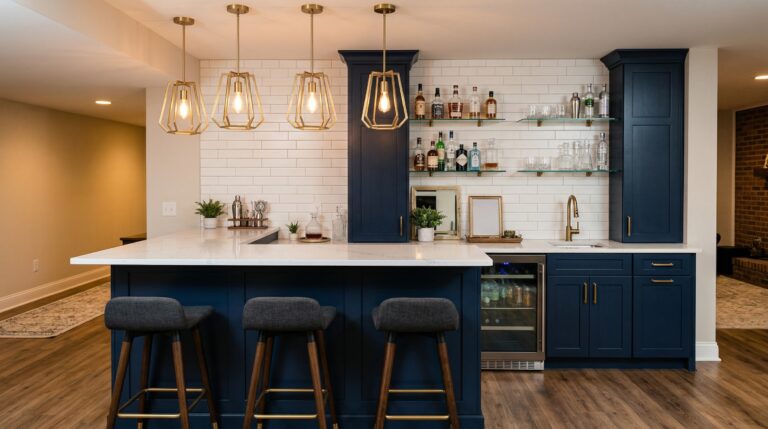
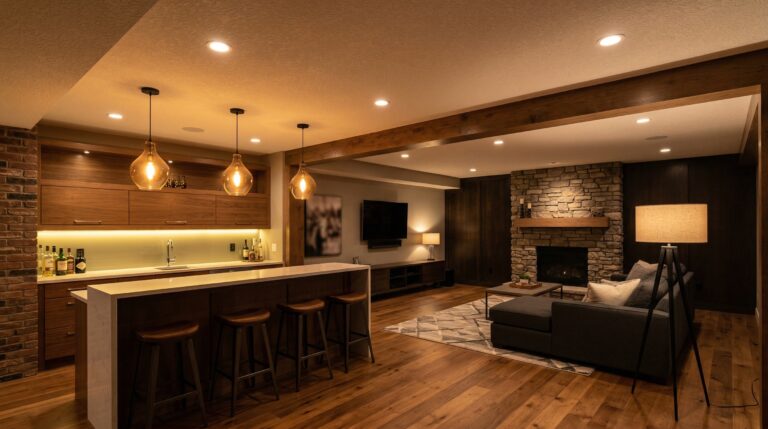
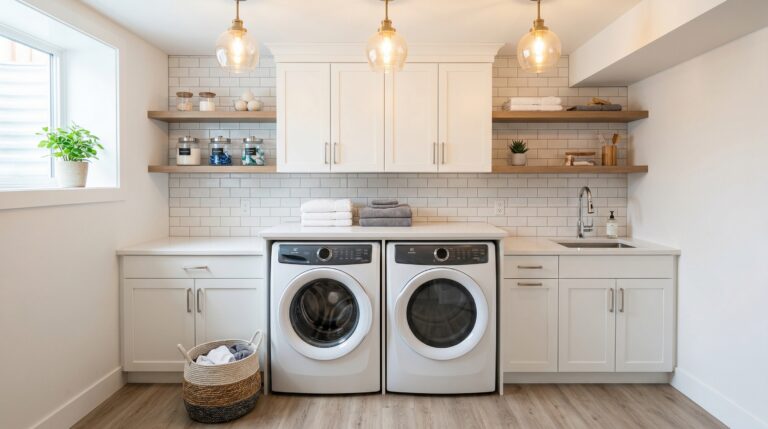
Not every basement is a sprawling 1,500-square-foot blank canvas. Many Utah homes — especially ramblers from the 1960s-80s, split-levels, and older construction — have compact basements of 400-800 square feet with lower ceilings, support columns, and awkward layouts.
Good news: a small basement doesn’t mean a useless basement. With smart design, every square foot pulls its weight. We’ve finished hundreds of compact basements across Utah and learned exactly what works in tight spaces.
Layout & Design Strategies
1. The Open-Concept Multi-Use Room
In a small basement, walls eat square footage. Instead of dividing 600 square feet into three tiny rooms, keep it open and define zones with furniture, area rugs, and lighting instead of walls.
Example layout (600 sq ft):
– Living/TV zone with sectional and mounted TV
– Office nook in one corner with a desk and task lighting
– Play area along one wall with low storage bins
– All in one open space that feels much larger than three cramped rooms
Cost: $18,000-$28,000 for a basic open-concept finish
Pro Tip: The only rooms that truly need walls in a basement are bathrooms (plumbing + privacy) and bedrooms (egress + fire code). Everything else can stay open.
2. Built-In Everything
In small basements, freestanding furniture wastes space. Built-in solutions use every inch:
- Built-in desk along a wall (no legs stealing floor space)
- Floating shelves instead of bookcases
- Window seat with storage under egress windows
- Murphy bed that folds into the wall when not in use
- Built-in entertainment center recessed into the wall between studs
- Bench seating along walls with storage underneath
Cost: $500-$3,000 per built-in feature
3. The L-Shaped or Galley Layout
If your basement has a long, narrow shape (common in older Utah homes), embrace it. Design a galley layout with activity zones along the length:
Zone 1 (near stairs): Entry/mudroom/storage
Zone 2 (middle): Living/entertainment area
Zone 3 (far end): Bedroom or office
Run the layout like a train car — each zone flows into the next without wasted hallway space.
4. Light Colors and Strategic Lighting
Small basements feel smaller when they’re dark. Fight the cave effect with:
- Light wall colors — White, light gray, soft warm whites. Avoid dark colors on walls.
- Recessed LED lighting on dimmers — Adjustable brightness that opens up the space
- Under-cabinet LED strips along built-ins — Adds depth without overhead glare
- Light-colored flooring — Light gray LVP or light carpet
- Mirrors on walls — The oldest trick in the book, and it works
- Egress windows — Even one window dramatically changes how a basement feels
5. Pocket Doors and Barn Doors
Standard doors need 3 feet of swing clearance. In a small basement, that’s a lot of wasted floor space. Pocket doors slide into the wall (zero floor space). Barn doors slide along the wall (minimal floor space).
Cost: Pocket doors $300-$800 installed. Barn doors $200-$600 plus hardware.
Room-Specific Ideas for Small Basements
6. Compact Home Office (50-80 sq ft)
A productive home office doesn’t need a lot of space. A corner or nook is enough.
What you need:
– Built-in desk (30″ deep minimum)
– Shelving above the desk
– Dedicated electrical with enough outlets for equipment
– Ethernet drop (Wi-Fi through basement floors is unreliable)
– Task lighting plus ambient overhead
– Sound-absorbing panel on the wall behind your video call background
Cost: $3,000-$8,000 as part of a larger basement finish
7. Half Bathroom (25-35 sq ft)
A half bath (toilet + sink) fits in a remarkably small footprint. Even 5×5 feet works if the layout is smart.
Space-saving tricks:
– Corner sink or wall-mounted sink (no vanity eating floor space)
– Pocket door instead of swing door
– Wall-mounted toilet for easier cleaning and visual space
Cost: $5,000-$10,000
Pro Tip: Even if you don’t add a full bathroom, a half bath in the basement is one of the highest-value additions you can make. Nobody wants to walk upstairs every time.
8. Cozy Media Nook (100-150 sq ft)
Not a full theater — just a dedicated spot for watching TV or gaming with proper seating and sound.
- 65″ TV mounted on the wall (takes zero floor space)
- Love seat or oversized bean bags instead of a sectional
- Sound-dampening panels on the back wall
- Dimmable lighting
- Built-in shelving for games, controllers, and media
Cost: $5,000-$12,000 (as part of a finish, not counting TV/equipment)
9. Guest Bedroom (100-120 sq ft)
A legal bedroom needs an egress window, a closet, and enough space for a bed. An 10×12 room checks all the boxes.
Space maximizers:
– Queen Murphy bed that folds up to reveal a desk or shelving
– Built-in nightstands (floating shelves beside the bed)
– Closet with organization system (wire shelving, double-hung rods)
– Recessed lighting (no table lamps eating surface space)
Cost: $8,000-$15,000 (including egress window)
10. Playroom That Converts (150-200 sq ft)
Design the kids’ playroom to convert as they grow. What’s a playroom at age 5 becomes a gaming room at 12 and a study at 16.
Convertible features:
– Wall-mounted fold-down table (activity table now, study desk later)
– Modular storage cubes that reconfigure
– Chalkboard or whiteboard wall (creative play now, homework later)
– Neutral base colors with changeable accent decor
11. Laundry Room Upgrade (40-60 sq ft)
If your washer/dryer already lives in the basement, build a proper laundry room around them. Even 6×8 feet is enough.
- Counter over front-load machines for folding
- Overhead cabinets for supplies
- Hanging rod for air-dry items
- Pull-out hamper bins
- Utility sink if plumbing allows
Cost: $3,000-$7,000
12. Exercise Corner (80-120 sq ft)
You don’t need 400 square feet for a home gym. A compact exercise area fits more than you’d think:
- Rubber flooring section ($2-$4/sq ft)
- Wall-mounted fold-up weight bench
- Resistance band anchor points in walls
- Mirror on one wall
- Ceiling-mounted TRX or pull-up bar
- TV mounted for workout videos
Cost: $2,000-$5,000 (space, not equipment)
13. Reading Nook / Library Wall
Turn a corner or alcove into a dedicated reading retreat:
- Floor-to-ceiling bookshelves on one or two walls
- Comfortable armchair with good task lighting
- Small side table
- Acoustic isolation from the rest of the basement (even just heavy curtains)
Cost: $1,500-$4,000
14. Craft/Hobby Alcove (60-100 sq ft)
A dedicated workspace that doesn’t dominate the basement:
- Built-in work surface at counter height (36″)
- Pegboard wall for tools and supplies
- Overhead cabinets to keep supplies dust-free
- Good task lighting (daylight-spectrum LEDs)
- Easy-clean flooring under the work area
Cost: $2,000-$5,000
15. Pet Space (30-50 sq ft)
A dedicated pet area with:
- Built-in feeding station (raised bowls, food storage drawer below)
- Dog crate nook built into cabinetry
- Cat litter box enclosure with ventilation
- Easy-clean tile flooring
- Pet wash station (if plumbing is nearby)
Cost: $500-$3,000
Visual Tricks for Small Basements
16. Horizontal Design Lines
Horizontal lines make spaces feel wider. Use them through:
- Shiplap or horizontal plank walls
- Long, horizontal shelving
- Wide-plank flooring laid lengthwise
- Horizontal stripe accent walls
17. Consistent Flooring Throughout
Using the same flooring throughout an open basement (no transitions between rooms) makes the space feel continuous and larger. LVP works perfectly for this — one material from wall to wall.
18. Strategic Mirror Placement
A large mirror on the wall opposite any window (especially an egress window) doubles the natural light and creates the illusion of depth. It’s the most cost-effective visual trick available.
Cost: $50-$300 for a large wall mirror
19. Minimalist Color Palette
Stick to 2-3 colors maximum throughout a small basement. Busy patterns and contrasting colors in a compact space create visual noise that makes it feel cluttered even when it’s clean.
Winning palette for small Utah basements:
– Walls: Light warm white or pale gray
– Trim: White
– Accent: One statement color in furniture or decor
– Flooring: Light to medium tone
20. Ceiling Treatment That Adds Height
In low-ceiling basements (7-7.5 feet):
- Paint the ceiling white — It disappears visually
- Use flush-mount or recessed lighting — Nothing hanging down
- Avoid crown molding — It visually lowers the ceiling
- Run vertical elements on walls — Vertical shiplap or tall artwork draws the eye up
- Consider a painted exposed ceiling — You gain the inches that drywall would steal
Pro Tip: In a 7-foot basement, every inch matters. Standard drywall on the ceiling loses 1-1.5 inches. A painted exposed ceiling loses zero. That might sound trivial, but the difference between 6’10” and 7′ is the difference between “this feels tight” and “this feels fine.”
Small Basement Finishing Costs in Utah
| Scope | Size | Estimated Cost |
|---|---|---|
| Basic open finish | 400-600 sq ft | $15,000 – $25,000 |
| Mid-range (bedroom, half bath, living area) | 500-800 sq ft | $25,000 – $40,000 |
| Premium (full bath, custom built-ins, high-end finishes) | 500-800 sq ft | $35,000 – $55,000 |
Small basements cost more per square foot than large ones because fixed costs (permits, bathroom plumbing, egress windows, HVAC) are spread across fewer square feet. But the total project cost is still lower, making it accessible for more homeowners.
Ready to Maximize Your Small Basement?
Small basements are our specialty. We’ve turned 400-square-foot spaces into the most-used rooms in the house. Call 801-515-3473 or get your free estimate — we’ll show you what’s possible.
Ready to Start Your Basement Project?
Get a free, no-obligation quote from Utah's trusted basement finishing experts.
Get Free Quote